
How Relationship OCD Can Affect Your Daily Life and Relationships
Educational Disclaimer: This article is for educational purposes only and is not a substitute for a professional diagnosis or mental health evaluation.
Introduction

If you can’t stop questioning your relationship, you may wonder whether those thoughts mean something is wrong. You might repeatedly ask yourself whether you truly love your partner, whether they’re “the right person,” or whether staying together is a mistake. Even when your relationship is going well, the doubts can return without warning and be difficult to let go.
For some people, this pattern is more than ordinary relationship uncertainty. It can be part of relationship OCD (ROCD), a form of obsessive-compulsive disorder (OCD) in which intrusive thoughts become focused on your relationship. These thoughts are unwanted, repetitive, and distressing. They may continue despite reassurance or evidence that your relationship is healthy.
Relationship OCD is a treatable form of OCD. Treatment focuses on the OCD rather than determining whether your relationship is right or wrong. It is an individual form of OCD treatment, not couples counseling. Understanding how ROCD works can help you recognize why these thoughts continue and how OCD-focused treatment may help.
What Is Relationship OCD (ROCD)?

Relationship OCD (ROCD) is a form of obsessive-compulsive disorder (OCD) in which obsessions and compulsions become focused on your romantic relationship. The intrusive thoughts are driven by OCD. They are not evidence that something is wrong with your relationship.
You may experience persistent doubts about:
- Whether you truly love your partner
- Whether your partner loves you enough
- Whether your relationship feels “right”
- Whether you’re making the wrong long-term decision
- Whether small imperfections mean your relationship won’t last
These thoughts can feel urgent and emotionally convincing. Trying to answer them or seek reassurance may bring temporary relief. The doubts often return.
OCD involves a cycle of obsessions and compulsions. Obsessions are intrusive, unwanted thoughts, images, or urges that create anxiety or distress. In relationship OCD, they often focus on uncertainty about your relationship. Compulsions are behaviors or mental rituals that reduce anxiety. They may provide short-term relief. Over time, they can keep the OCD cycle going.
Relationship OCD can occur in new relationships, long-term relationships, engagements, or marriages. It can also affect people who are dating or considering a long-term commitment.
Experiencing relationship OCD does not automatically mean something is wrong with your relationship. Treatment focuses on the OCD itself. The goal is to help you respond differently to obsessions, compulsions, and uncertainty, not to determine whether your relationship is right or wrong. Learn more about OCD treatment and how it can help.
Common Signs and Symptoms of ROCD
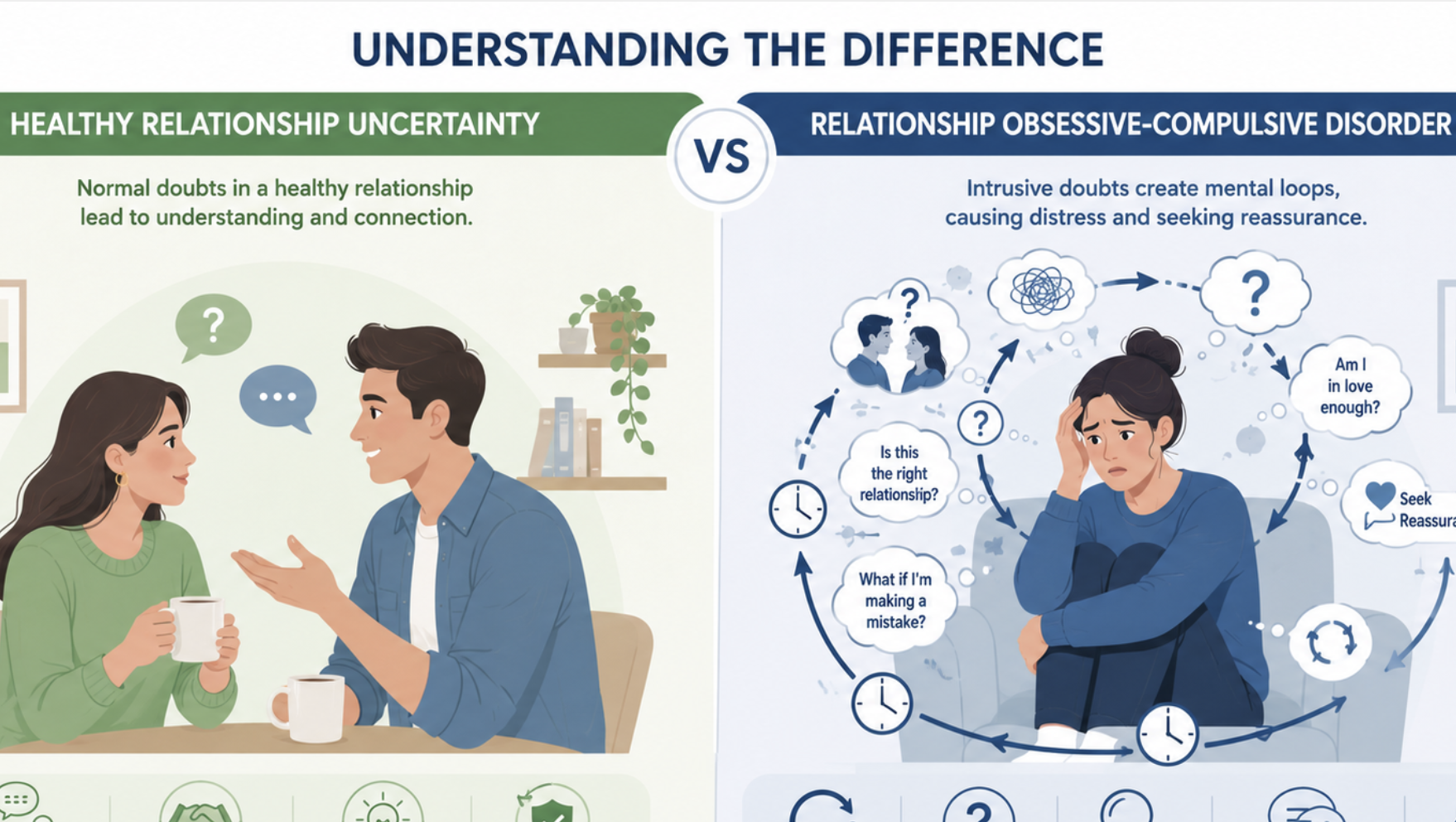
Everyone has questions about their relationship from time to time. Relationship OCD is different because the intrusive thoughts become persistent, distressing, and difficult to dismiss. Only a licensed mental health professional can diagnose OCD. However, people with relationship OCD may experience patterns such as:
Persistent Intrusive Doubts
The same questions may repeat throughout the day, including:
- “Do I really love my partner?”
- “What if I’m settling?”
- “What if I’ve made the wrong choice?”
- “What if these doubts mean we should break up?”
The distress often comes from feeling unable to tolerate uncertainty or reach a sense of certainty.
Constant Reassurance Seeking
You may repeatedly seek reassurance from:
- Your partner
- Friends or family
- Online articles
- Relationship forums
- Personality or compatibility quizzes
Reassurance may reduce anxiety for a short time. The relief often fades, and the doubts return.
Mental Reviewing
You may spend hours replaying conversations, memories, or feelings in your mind. You might ask yourself:
- Did I feel happy enough during dinner?
- Was I excited enough when we first met?
- Did I react the way someone in love “should” react?
Repeated mental reviewing can become a compulsion that keeps the OCD cycle going.
Comparing Your Relationship
You may compare your relationship with:
- Other couples
- Social media posts
- Past relationships
- Movies or television portrayals of romance
Instead of providing certainty, these comparisons often increase doubt.
Looking for Absolute Certainty
OCD often creates a strong need for certainty. With relationship OCD, you may believe you must be completely certain that your partner is the right person before you can feel at ease. Because no relationship offers complete certainty, the doubts often continue.
Avoiding Relationship Triggers
You may avoid situations that trigger intrusive thoughts, such as:
- Romantic movies
- Weddings
- Conversations about marriage
- Spending quality time with your partner because you fear analyzing your feelings
Avoidance may reduce anxiety for a short time. Over time, it can reinforce the OCD cycle.
These experiences alone do not mean you have relationship OCD. Similar thoughts can occur for many reasons. Only a licensed mental health professional can diagnose OCD through a comprehensive evaluation.
How ROCD Is Different From Normal Relationship Doubts
Every relationship includes moments of uncertainty. You may wonder how to handle conflict, whether your goals align, or how to navigate life changes together. These questions are a normal part of a healthy relationship.
Relationship OCD is different. Instead of helping you work through a concern, the doubts become intrusive and repetitive. They often continue even when your relationship is stable. Rather than helping you reach a decision, they lead to obsessions, compulsions, temporary relief, and more doubt.
Some important differences include:
| Normal Relationship Doubts | Relationship OCD |
|---|---|
| Often relate to a specific situation or relationship change | Can occur even when the relationship is stable |
| Usually lessen after reflection or a conversation | Return despite reassurance |
| Help guide communication and decision-making | Create ongoing anxiety and a strong need for certainty |
| Do not take over your daily life | Can occupy hours of your attention |
| Allow room for uncertainty | Lead to compulsions that try to eliminate uncertainty |
One of the most difficult parts of relationship OCD is that the intrusive thoughts often feel believable. You may worry that the thoughts reveal a hidden truth about your relationship. OCD often focuses on what matters most to you. Because your relationship is important, it can become the focus of obsessions and compulsions.
Reassurance, analyzing your feelings, or searching for the “perfect” answer may provide temporary relief. The doubts often return.
Relationship OCD treatment focuses on helping you respond differently to obsessions, compulsions, and uncertainty. It can help determine when these doubts are based in OCD or real relationship issues that need to be addressed. If you would like to learn how this approach works, you can read more about OCD treatment.
How ROCD Affects Daily Life and Relationships
Relationship OCD can affect more than your thoughts about your partner. The cycle of obsessions and compulsions can make everyday life feel mentally exhausting. You may find it difficult to concentrate at work because you’re analyzing a conversation with your partner. Time with friends or family may be interrupted by intrusive thoughts. Even enjoyable moments can become another opportunity to question your relationship or seek certainty.
Relationship OCD may affect:
- Your concentration at work or school
- Your sleep because of persistent intrusive thoughts or rumination
- Decisions about your future
- Emotional closeness with your partner
- Confidence in your own judgment
- Your overall stress and anxiety
You may also feel guilty for questioning someone you care about. You may worry that the intrusive thoughts reflect your character or commitment. These thoughts can be distressing, even when you do not want them.
Because the doubts feel convincing, you may respond with compulsions such as:
- Repeatedly asking your partner for reassurance
- Mentally checking whether you “feel enough” love
- Spending hours searching online for relationship advice
- Comparing your relationship with other relationships
- Testing your emotional reactions during everyday interactions
These compulsions may reduce anxiety for a short time. The relief usually does not last. The doubts often return, and the OCD cycle continues.
Relationship OCD can also affect your relationship. Your partner may not understand why the same questions continue after many conversations. They may unintentionally become part of the reassurance cycle by offering repeated reassurance. While this may provide temporary relief, it does not address the OCD itself.
This does not mean your relationship is failing. It means OCD is affecting how you experience uncertainty. Treatment focuses on helping you respond differently to obsessions, compulsions, and uncertainty. If you’d like to learn more about this approach, you can read about OCD treatment.
Is ROCD the Same as Couples Therapy?
No. Relationship OCD is an individual form of obsessive-compulsive disorder (OCD). It is not treated through couples counseling. Although the intrusive thoughts focus on your relationship, treatment focuses on the OCD symptoms you are experiencing. The goal is to help you respond differently to obsessions, compulsions, and uncertainty.
Treatment may include:
- Understanding how OCD affects your thoughts and behaviors
- Identifying obsessions and compulsions
- Learning to respond differently to uncertainty
- Reducing reassurance seeking and checking behaviors
- Practicing new responses through Exposure and Response Prevention (ERP), a structured form of Cognitive Behavioral Therapy (CBT) that helps you gradually face situations that trigger obsessions without relying on compulsions or avoidance
This approach is different from couples therapy. Couples therapy focuses on communication, conflict resolution, and relationship dynamics between partners. Relationship OCD treatment focuses on the OCD itself.
If you have relationship concerns that are separate from OCD, different types of support may be appropriate. At the Center for Mental Wellness, relationship OCD is treated as an individual OCD condition using evidence-based therapy. The Center for Mental Wellness, however, also offers couples counseling, which may help in resolving relationship issues that are separate from ROCD. If you’d like to learn more about how individual OCD treatment works, you can read about OCD treatment.
How ROCD Is Treated
Relationship OCD is treated using the same evidence-based approaches used for other forms of obsessive-compulsive disorder (OCD). One of the primary treatments is Exposure and Response Prevention (ERP), a structured form of Cognitive Behavioral Therapy (CBT). During ERP, you gradually approach thoughts, images, situations, objects, or sensations that trigger obsessions. You then practice responding without compulsions or avoidance.
During ERP, you may work on:
- Gradually approaching situations that trigger intrusive thoughts
- Reducing reassurance seeking, checking, and other compulsions
- Learning to tolerate uncertainty without responding to obsessions
- Building confidence in responding differently to intrusive thoughts over time
Your treatment plan may also include Cognitive Behavioral Therapy (CBT). CBT helps you identify and change thought patterns that contribute to anxiety and compulsive behaviors.
Depending on your symptoms, treatment may focus on:
- Understanding how OCD affects your daily life
- Identifying your obsessions and compulsions
- Recognizing patterns that maintain anxiety
- Developing practical skills to respond differently to intrusive thoughts and uncertainty
If you’ve spent months or years searching for certainty, it can be discouraging when the doubts continue to return. Therapy can help determine when these doubts are based in OCD or real relationship issues that need to be addressed. does not focus on proving whether your relationship is right or wrong. It focuses on helping you respond differently to obsessions, compulsions, and uncertainty. If you’d like to learn more about this approach, you can read about OCD treatment.
Frequently Asked Questions
Is relationship OCD a real diagnosis?
Relationship OCD (ROCD) is a recognized presentation of obsessive-compulsive disorder (OCD). It describes OCD in which obsessions and compulsions focus on a romantic relationship. A licensed mental health professional can determine whether your symptoms are consistent with OCD.
What’s the difference between ROCD and normal relationship doubts?
Normal relationship doubts usually relate to a specific situation and often improve after reflection or conversation. Relationship OCD involves intrusive, repetitive doubts that persist despite reassurance. These doubts are often accompanied by compulsions such as checking, analyzing, or seeking certainty.
Is ROCD treated with couples therapy?
No. Relationship OCD is treated as an individual form of OCD, not through couples counseling, though getting help for ROCD can help your relationship. Treatment focuses on helping you respond differently to obsessions, compulsions, and uncertainty using evidence-based approaches such as Exposure and Response Prevention (ERP).
What treatment works best for ROCD?
Exposure and Response Prevention (ERP), a structured form of Cognitive Behavioral Therapy (CBT), is one of the primary evidence-based treatments for OCD. Your treatment plan may also include CBT based on your symptoms and individual treatment needs.
Can ROCD happen in a happy, healthy relationship?
Yes. Relationship OCD can occur even when your relationship is healthy and supportive. Intrusive thoughts do not automatically mean there is a problem with your relationship. OCD often focuses on the people and experiences that matter most to you.
Schedule a Consultation
If intrusive relationship doubts are taking over your day, you do not have to keep facing them alone. Relationship OCD is a treatable form of obsessive-compulsive disorder, and evidence-based therapy can help you respond differently to the cycle of obsessions and compulsions.
At the Center for Mental Wellness, Dr. Eunice Kim provides individual therapy for adults experiencing OCD using approaches such as Exposure and Response Prevention and Cognitive Behavioral Therapy. Treatment is tailored to your individual symptoms and goals. You can learn more about OCD therapy, learn more about Dr. Eunice Kim, or schedule a consultation.
More to Read
- Treatment for Depression: How CBT Can Help
- 3 Practical Tips About How to Teach your Child Resilience
- God of Coins Casino: Ein Blick auf die Sicherheitsmaßnahmen
- Comment fonctionne le portail joueur Europe Fortune Casino au quotidien
- Rich Royal Casino: Ein Blick hinter die Kulissen
- How Relationship OCD Can Affect Your Daily Life and Relationships
- Quels éléments composent l’offre intégrale de Tiki Taka Casino
- How to Feel Less Frustrated with Your Partner
- How to Know What Kind of Therapy Your Child Needs
- 5 Healthy Ways to Talk About Body Image with Your Daughter